“Electrical current stands in for human connection when Mrs. Givings, trying to get through to her Edison-admiring husband, tells him that between alternating or direct current she prefers” direct (87).
Mrs. Givings wants her husband to use the vibrator “as a tool for intimacy, as a way of growing closer together by giving his wife pleasure” (87).
From Drama and Theatre of Sarah Ruhl
History of Electricity: Turning Night Into Day
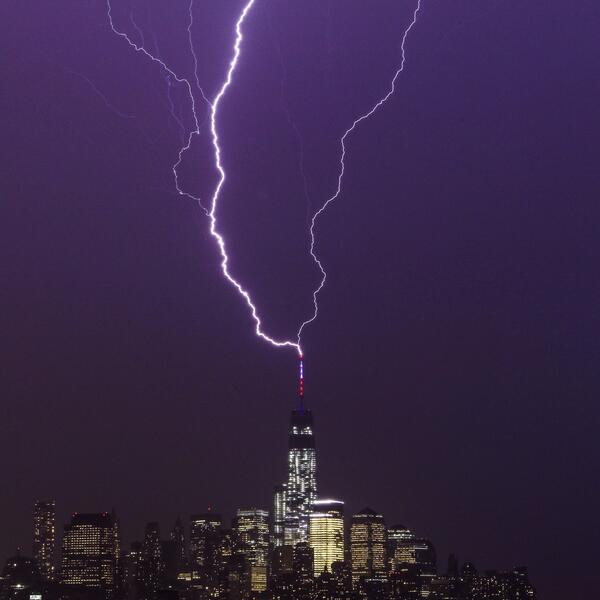
Long before Benjamin Franklin’s experiments in the 18th century, William Gilbert was one of the first scientists to document the concept of electricity in his book De Magnete (1600). Later, Robert William Boyle published Experiments and Notes about the Mechanical Origine or Production of Electricity (1675). In the 1740’s, Ben Franklin conducted experiments that contributed further to the understanding of electricity and invented the lightning rod, which provided a safer way for lightning to reach the ground and thus protected buildings from fires caused by lightning.
The War of the Currents
In the late 19th century, three brilliant inventors, Thomas Edison, Nikola Tesla and George Westinghouse, battled over which electricity system—direct current (DC) or alternating current (AC)–would become standard. During their bitter dispute, dubbed the War of the Currents, Edison championed the direct-current system, in which electrical current flows steadily in one direction, while Tesla and Westinghouse promoted the alternating-current system, in which the current’s flow constantly alternates.
–History.com

Tesla was a young Serbian engineer who immigrated to America and worked for Edison to improve direct current (DC) generators. Tesla had been working on alternating current (AC) technology, but Edison claimed it would have no future. By 1888, Tesla quit his job, had received numerous patents for his AC technology, and had sold those patents to industrialist George Westinghouse of the Westinghouse Electric Company who had become a primary competitor to Edison.
The battle for public opinion quickly turned into a smear campaign by Edison, who was still riding the fame and success after having just invented the phonograph. Thomas Edison had established DC as “the standard for electricity distribution” and did not want to lose his patent royalties he had achieved. Edison staged a string of animal electrocutions, consisting of stray cats and dogs, and a few cattle and horses, to demonstrate the danger of alternating current. One of these highly-publicized electrocutions was performed on an elephant named Topsy, who was killed instantly after being shocked with a 6,600-volt AC charge (“Jan. 4, 1903: Edison Fries an Elephant to Prove His Point”). This media campaign consisted of Edison arguing for the deadliness of AC, using the term “Westinghoused” to describe an execution by electrocution.
In 1890, convicted murderer William Kemmler became the first person to die in the electric chair. The apparatus, designed by an electricity salesman secretly on Edison’s payroll, was powered by a Westinghouse AC generator.
–History.com
Edison ultimately lost the Current War. AC could be distributed over long distances much more economically than DC. The Westinghouse Electric Company won the contract to supply electricity to the 1893 World’s Fair in Chicago, creating a dazzling showcase for Tesla’s AC system. In 1896, Westinghouse also won a contract for a hydro-electric power plant at Niagara Falls that began delivering electricity all the way to Buffalo, New York, 26 miles away.
A Timeline of Electricity
The following selections are sourced from The Historical Archive
1752 – By tying a key onto a kite string during a storm, Benjamin Franklin proved that static electricity and lightning were the same. His correct understanding of the nature of electricity paved the way for the future.
1808 – Humphry Davy invented the first effective “arc lamp.” The arc lamp was a piece of carbon that glowed when attached to a battery by wires.
1831 – Using his invention the induction ring, Michael Faraday proved that electricity can be induced (made) by changes in an electromagnetic field. Faraday’s experiments about how electric current works, led to the understanding of electrical transformers and motors.
Joseph Henry separately discovered the principle of electromagnetic induction but didn’t publish his work. He also described an electric motor.
“One of the first major breakthroughs in electricity occurred in 1831, when British scientist Michael Faraday discovered the basic principles of electricity generation. Building on the experiments of Franklin and others, he observed that he could create or “induce” electric current by moving magnets inside coils of copper wire. The discovery of electromagnetic induction revolutionized how we use energy. In fact, Faraday’s process is used in modern power production, although today’s power plants produce much stronger currents on a much larger scale than Faraday’s hand-held device.”
– “History of Electricity”
1844 – Samuel Morse invented the electric telegraph, a machine that could send messages long distances across wire.
1878 – Joseph Swan, and Englishman, invented the first incandescent lightbulb (also called an “electric lamp”). His lightbulb burned out quickly.
– Charles Brush developed an arc lamp that could be powered by a generator.
– Thomas Edison founded the Edison Electric Light Co. (US), in New York City. He bought a number of patents related to electric lighting and began experiments to develop a practical, long-lasting light bulb.
1879 – After many experiments, Thomas Edison invented an incandescent light bulb that could be used for about 40 hours without burning out. By 1880 his bulbs could be used for 1200 hours.
1879 – Electric lights (Brush arc lamps) were first used for public street lighting, in Cleveland, Ohio.
– California Electric Light Company, Inc. in San Fransicso was the first electric company to sell electricity to customers. The company used two small Brush generators to power 21 Brush arc light lamps.
1881 – The electric streetcar was invented by E.W. v. Siemens
1882 – Thomas Edison opened the Pearl Street Power Station in New York City. The Pearl Street Station was one of the world’s first central electric power plants and could power 5,000 lights. The Pearl Street Station was a direct current (DC) power system, unlike the power systems that we use today which use alternating current (AC).
– The first hydroelectric station opened in Wisconsin.
– Edward Johnson first put electric lights on a Christmas tree.
1884 – Nikola Tesla invented the electric alternator, an electric generator that produces alternating current (AC). Until this time electricity had been generated using direct current (DC) from batteries. AC electrical systems are better for sending electricity over long distances.
– Steam turbine generator, capable of generating huge amounts of electricity, was invented by Sir Charles Algernon Parsons.
1888 – Nikola Tesla demonstrated the first “polyphase” alternating current (AC) electrical system. His AC system including everything needed for electricity production and use: generator, transformers, transmission system, motor (used in appliances) and lights. George Westinghouse, the head of Westinghouse Electric Company, bought the patent rights to the AC system.
– The first use of a large windmill to generate electricity was built by inventor Charles Brush. He used the windmill to charge batteries in the cellar of his home in Cleveland, Ohio.
1893 – The Westinghouse Electric Company used an alternating current (AC) system to light the Chicago World’s Fair.
– A 22 mile AC powerline was opened, sending electricity from Folsom Powerhouse in California to Sacramento.
1908 – Electric vacuum cleaner – J. Spangler.
Electric washing machine- A. Fisher.
1911 – Electric air conditioning – W. Carrier.
 In The Next Room or the vibrator play